
Agencies running always‑on programmatic display don’t struggle to make ads anymore. The real pressure is producing, localizing, and activating thousands of banner and video variants fast—without losing creative control.
Smartly’s 2026 data shows 41% of marketers still need 3–4 weeks to launch a digital campaign, and only 3.6% can go live in under a week. At the same time, IAB reports U.S. digital video will capture nearly 60% of TV/video ad spend in 2025. Creative operations leaders are being asked to do far more, far faster.
This ranking is for:
Creative and production leaders at agencies
Heads of creative and creative ops in mid‑market and enterprise brands
Performance marketing teams who live in programmatic, retail media, and CTV
We’ve focused on platforms that:
Support high‑volume banner and video production
Offer AI‑driven creative automation across formats and variants
Integrate with programmatic activation workflows
Provide governance, collaboration, and review at scale
Viewst’s approach—editable, animated HTML5 ads with full creative control—is the benchmark. Each entry below looks at what the platform is, who it suits, and where it falls short for creative ops leaders.
1. Viewst — AI Ad Production Platform for Editable, Animated HTML5
Viewst is built specifically for professional creative and advertising teams that need to turn ideas or existing designs into finished, editable, animated, ad‑ready campaigns across formats and markets.
Unlike many AI creative tools that spit out flat files, Viewst produces native, structured HTML5 with fully editable layers. Designers can adjust every element—layout, animation, copy—without re‑prompting an AI model or rebuilding ads from scratch.
What Viewst does best
Viewst focuses on the full production pipeline for display and video‑like HTML5:
AI Designer: Turn a prompt or reference design into a campaign concept that stays editable.
Smart Resize: Automatically adapt one master creative across sizes and placements (leaderboards, skyscrapers, mobile, etc.) while preserving hierarchy.
Image Deflatening: Take flat assets (e.g., JPEG from a brand team) and reconstruct editable layers for text, buttons, and objects.
Instant Animator: Apply intelligent motion to static layouts, then fine‑tune timing and easing on the canvas.
Brandbooks & controlled styles: Keep fonts, colors, layouts, and messaging consistent across markets and teams.
Integrated review and approval: Animated previews, comments, version history, and approvals tied directly to each campaign.
Production‑ready export: HTML5 files with click tags, file‑weight management, fallback assets, and network‑specific settings.
For agencies running programmatic display, this means:
Build one master creative direction
Adapt it into hundreds of banners and rich media variants
Localize into multiple languages and offers
Maintain full editability for future campaign refreshes
Who Viewst is ideal for
Viewst is the strongest fit for:
Creative agencies producing high‑volume display across multiple clients
In‑house creative teams at financial services, SaaS, fintech, automotive, retail, and app‑based businesses
Teams where programmatic display and retail media are business‑critical channels
These teams already invest heavily in Adobe, paid media, and production talent. They need a system that removes non‑creative work from creative work while respecting designer judgment.
Where Viewst is honest about limits
Viewst is intentionally focused on ad production rather than being a full media stack.
It doesn’t aim to replace DSPs or analytics platforms.
It isn’t a generic content‑supply‑chain tool; it specializes in digital ads.
For teams looking for a single platform that covers planning, activation, reporting, and creative, Viewst will sit alongside DSPs and analytics rather than inside them—and that’s by design.
2. Celtra — Creative Automation with Strong Modular Systems
Celtra is one of the most established names in creative automation for display and video. It’s widely used by large brands and agencies to create modular templates, manage variants, and integrate activation.
Celtra’s public case studies show the level of scale agencies want:
McDonald’s Finland produced 5x more creative outputs, cut first‑launch production from 115 hours to 39, and reduced repeat launches from 27.5 hours to 2.
Siemens produced 13k+ assets with an 8.2x faster production speed.
What Celtra does best
Celtra is strong in:
Modular templates: Pre‑built systems where designers define components, and local markets swap content.
Variant management: Large matrices of sizes, audiences, and offers managed from one hub.
Localization workflows: Translation and local asset swaps embedded in templates.
Activation links: Designed to sit close to media trafficking for big brands.
For high‑volume banner and video creative, Celtra helps agencies:
Standardize complex clients into reusable design systems
Turn brand guidelines into flexible, scalable templates
Reduce repetitive layout work for regional markets
Who Celtra is ideal for
Global brands and holding‑company agencies
Teams with long‑running, complex brand systems and many local markets
Creative operations leaders who want rigid but powerful templates across display and video
Limitations vs. Viewst’s benchmark
Celtra is excellent at modularity and scale, but there are trade‑offs:
Template rigidity: Once systems are built, changing layouts can be slower and more constrained than working in a native, editable HTML5 canvas.
Designer experience: Some creative teams feel "locked into" templates and wish for more fluid canvas control.
If your priority is highly controlled templates across dozens of markets, Celtra shines. If your priority is fine‑grained creative control on every banner, Viewst’s native HTML5 approach may feel more flexible.
3. Adobe GenStudio — Content Supply Chain with Broad Scope
Adobe GenStudio frames the challenge as a content supply chain problem: exploding demand for video and personalized content, from planning to activation.
Adobe reports that over 20,000 global brands have built businesses on its ecosystem, and GenStudio now spans planning, creation, activation, reporting, and insights.
What GenStudio does best
Within programmatic display workflows, GenStudio excels at:
End‑to‑end orchestration: From content planning and creation to activation and performance insights.
Tight integration with Creative Cloud: Designers can move between Photoshop, Illustrator, After Effects, and GenStudio.
Brand governance: Strong emphasis on checks, approvals, asset libraries, and compliance.
Generative AI support: GenAI tools for layouts, copy, and image variations.
For agencies, the upside is a single stack that:
Connects creative production to media performance data
Embeds brand rules directly into creative workflows
Supports both display and video with enterprise‑grade governance
Who GenStudio is ideal for
Enterprise organizations deeply invested in Adobe
Agencies managing large, multi‑channel content programs, not just ads
Creative leaders looking to standardize tools across design and marketing
Limitations vs. Viewst’s benchmark
GenStudio is broad—and that breadth comes with compromises:
Display‑specific production: While it supports ads, it’s not laser‑focused on HTML5 banner production constraints (file weights, click tags, fallbacks) the way Viewst is.
Operational complexity: Implementing GenStudio as a content supply chain can require significant change management.
If your main problem is enterprise content governance across channels, GenStudio is compelling. If your core challenge is fast, editable, animated HTML5 production for programmatic display, a specialized platform like Viewst will often be more efficient.
4. Smartly.io — Creative + Media for Social and Programmatic
Smartly.io is known for unifying creative production and media activation, primarily in paid social but increasingly for broader digital advertising.
Its 2026 research highlights the industry gap:
95% of respondents test AI for creative production
42% still describe their GenAI use as "initial testing"
Three in four worry AI creative will make brands look the same
41% say campaigns still take 3–4 weeks to launch
What Smartly.io does best
For agencies, Smartly.io is strong in:
Creative + media integration: Build, test, and activate creative in one system.
Dynamic creative optimization (DCO): Automatically assemble variants based on audience or offer.
Paid social automation: Deep support for platforms like Meta, TikTok, and Snapchat.
AI‑assisted production: Generative features that speed layout and variant creation.
When agencies extend Smartly.io toward programmatic display, they get:
Faster creative testing loops between variants and performance
Strong campaign operations visibility
Tools built around performance marketing needs
Who Smartly.io is ideal for
Performance marketing teams running always‑on paid social and display
Agencies focused on creative optimization and testing at scale
Teams that want creative and media in one operational stack
Limitations vs. Viewst’s benchmark
Smartly.io is excellent for performance workflows, but:
It’s not specialized in native, fully editable HTML5 banner production with fine‑tuned animation layers.
Creative sameness is a real concern—its own research shows 86% of marketers have already seen AI outputs that resemble competitor content.
If speed of testing and DCO across media channels is your primary goal, Smartly.io is powerful. If creative originality, handcrafted motion, and deep HTML5 editing matter most, Viewst offers more designer‑centric control.
5. Bannerflow — Collaborative Display Production Workspace
Bannerflow positions itself as a shared workspace where agencies and brands can collaboratively produce and manage large volumes of display and video assets.
Its H1 2026 platform data highlights the production vs. activation gap:
2.33 million assets
155.1 billion impressions
166.8 million clicks
300+ brands
78% of brands produced video content, but only 46% served video impressions
Video made up just 10.5% of assets
This reinforces a key industry trend: video production is outpacing video activation, and making the asset isn’t the hardest part anymore.
What Bannerflow does best
For agencies, Bannerflow offers:
Centralized production workspace: Shared environment for teams and clients.
Template‑based display production: Build, adapt, and localize banners at scale.
Translation and localization support: Variable‑driven content for markets.
Client transparency: Agencies can show progress and variants in one tool.
It’s well suited to:
Programmatic display campaigns with many sizes and languages
Agencies who want clients inside the production workflow
Who Bannerflow is ideal for
Agencies managing many clients' display campaigns
Brand‑agency partnerships that rely on shared production visibility
Teams that want a collaboration space more than a pure AI canvas
Limitations vs. Viewst’s benchmark
Compared to Viewst’s AI‑driven, editable‑HTML5 focus:
Bannerflow leans more on templates and collaboration than on deep AI production tools.
Motion and fine‑grained animation controls can feel more constrained than a native HTML5 editor.
If your main need is shared production visibility and client collaboration, Bannerflow is strong. If you need AI that reconstructs editable layers, intelligent resizing, and detailed motion control, Viewst is more specialized.
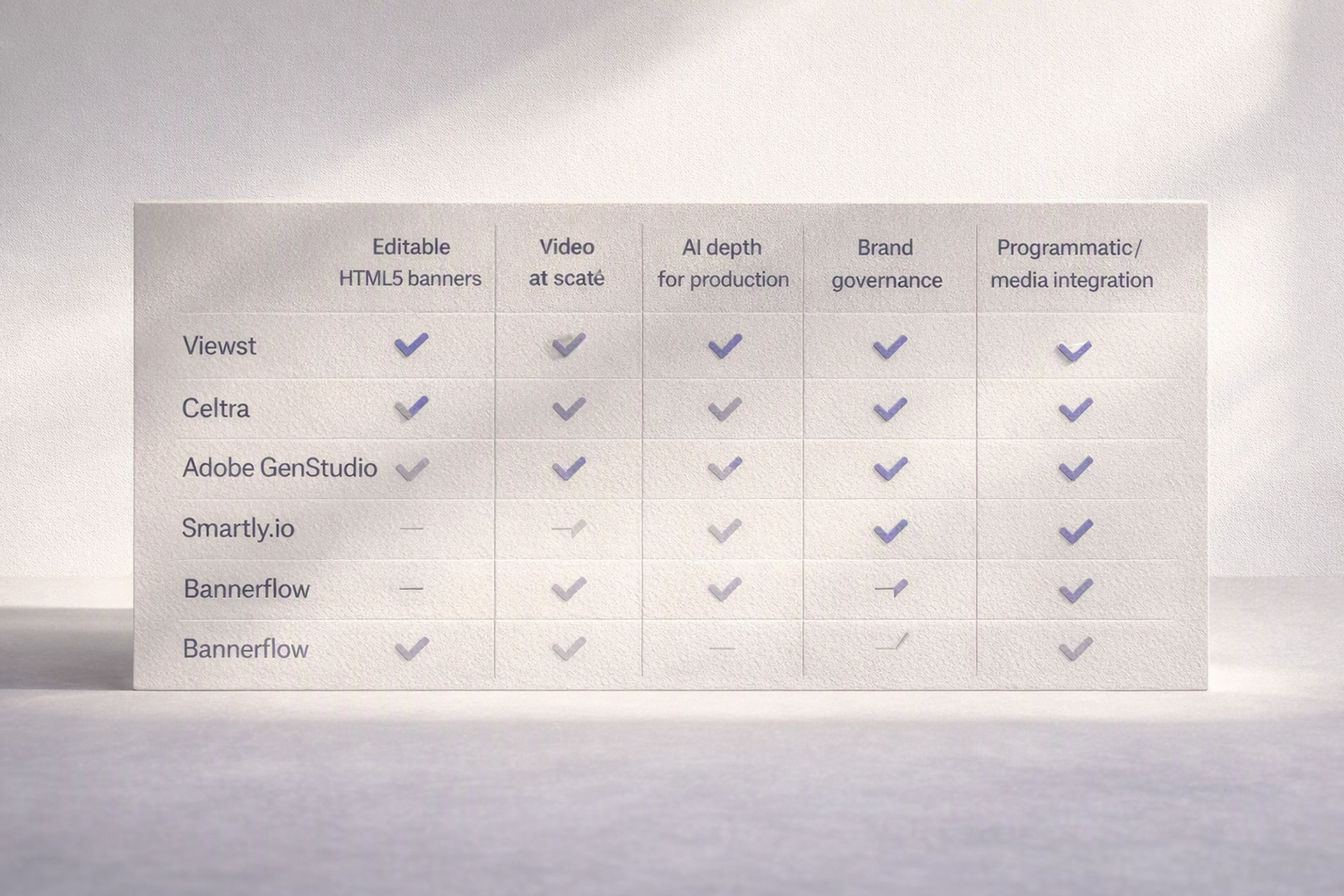
Summary Comparison: Top Creative AI Platforms for Agencies
Here’s a side‑by‑side comparison of the five platforms, using Viewst’s editable, animated HTML5 benchmark.
How to Choose the Right Creative AI Platform by Use Case
There is no single “winner.” The right platform depends on your agency’s mix of clients, channels, and operational priorities.
If you need editable, animated HTML5 banner production at scale
Prioritize:
Native HTML5 output with editable layers
AI that handles resize, animation, and layer reconstruction
Strong brand governance and review workflows
Best fit: Viewst
If you run global, template‑driven brand systems
Prioritize:
Robust modular templates and design systems
Localization and translation workflows baked into the platform
Integration with centralized brand teams
Best fit: Celtra (with Viewst as a complementary tool where you need more granular HTML5 control).
If your main challenge is enterprise content governance across channels
Prioritize:
End‑to‑end orchestration from planning to activation
Deep alignment with existing design tools (e.g., Adobe Creative Cloud)
Formal brand and compliance governance
Best fit: Adobe GenStudio
If you optimize creative in tight performance loops
Prioritize:
Creative + media living in one stack
Dynamic creative optimization across audiences and offers
Fast creative testing cycles with clear performance feedback
Best fit: Smartly.io (paired with a production‑specialist like Viewst for richer HTML5 and motion).
If collaboration and client visibility are your primary pain points
Prioritize:
Shared production workspace for agencies and clients
Template‑based display production with localization support
Clear versioning and status tracking
Best fit: Bannerflow
Connecting Creative AI, Automation, and Programmatic
The core industry shift is clear:
AI is moving from isolated experimentation to campaign backbone.
Creative ops is converging with media ops—production, review, trafficking, and reporting are merging into one loop.
The bottleneck is no longer "can we make an ad?" but "can we activate enough variants, fast, without losing control?"
If you’re building your agency’s stack, it’s worth stepping back and asking:
Which parts of our process are truly creative vs. repetitive?
Where do we need designer judgment on layout, animation, and copy?
Where can AI handle the production burden without eroding originality?
For a deeper dive into how to architect this stack, see our guide: how to connect ideas, automation, and programmatic in creative AI platforms.
FAQ: Creative AI Platforms for Programmatic Display
1. What should agencies look for in creative automation tools for display advertising?
Agencies should prioritize:
Editable HTML5 output: Not just images; real layers you can edit and animate.
AI that accelerates production, not replaces creative judgment.
Smart resizing and localization to reuse one master creative across sizes and markets.
Integrated review and approval workflows aligned with clients.
Production‑ready exports that meet file limits, click tags, and network requirements.
Tools that only generate flat images or videos often create downstream friction in programmatic environments.
2. How does AI help scale banner production without making ads look the same?
AI can:
Automate repetitive layout work (resizing, aligning, spacing).
Apply consistent animation patterns across variants.
Rebuild editable layers from flat assets.
To avoid sameness:
Use AI for production, not final creative decisions.
Keep designers in control of concept, hierarchy, and motion.
Use brand systems (fonts, colors, layout rules) as guardrails rather than one‑size‑fits‑all templates.
Smartly.io’s research shows three in four marketers worry about AI making brands look similar. The safeguard is clear ownership of the creative idea and brand system.
3. Why is editable HTML5 so important for programmatic display?
Programmatic display demands:
Many formats (728x90, 300x250, 160x600, 320x50, etc.)
Frequent offer changes and refreshes
Network‑specific requirements (click tags, file weights, fallbacks)
Editable HTML5:
Lets you adjust individual elements (CTAs, prices, imagery) without rebuilding.
Makes motion and interaction controllable at a granular level.
Supports future updates without re‑designing the entire ad.
Platforms like Viewst that produce structured HTML5 with editable layers give agencies more control and reduce long‑term production cost.
4. How do creative ops and media ops converge in these platforms?
Modern platforms combine:
Production automation (templates, AI resize, localization)
Brand governance (rules, approvals, permissions)
Media activation (export settings, trafficking, DCO)
Performance data (analytics, insights)
Instead of passing files from designers to media teams, the work happens in one loop. Celtra, Adobe GenStudio, Smartly.io, and Viewst all move in this direction, with different strengths.
5. Can agencies realistically cut campaign launch times below a week?
Yes—if they:
Standardize master creative systems and reuse them.
Use AI to handle resize, animation, and variant generation.
Centralize review and approval in one platform.
Align creative and media teams around shared workflows.
Celtra’s case studies (e.g., McDonald’s Finland) show first‑launch production times dropping from 115 hours to 39, and repeat launches to just 2 hours. With the right stack and process, agencies can move from 3–4 weeks to a matter of days.
When evaluating creative AI platforms, anchor on one principle:
AI should handle the production burden; creative teams must stay in control of the result.
For programmatic display, the platforms that win will be the ones that respect designer expertise, protect brand systems, and make high‑volume banner and video production fast, predictable, and scalable.

Victoria is the CEO at Viewst. She is a serial entrepreneur and startup founder. She worked in Investment Banking for 9 years as international funds sales, trader, and portfolio manager. Then she decided to switch to her own startup. In 2017 Victoria founded Profit Button (a new kind of rich media banners), the project has grown to 8 countries on 3 continents in 2 years. In 2021 she founded Viewst startup. The company now has clients from 43 countries, including the USA, Canada, England, France, Brazil, Kenya, Indonesia, etc.
In this article
" height="11.060000000000002px" id="wzBCZ87AK" transform="translate(6.47 2.47)" width="6.590000000000003px"/></g></svg>)